Showing posts with label Causes. Show all posts

Sunday, August 28, 2011

New Zealand Background

Pākehā Settlement
  • The private NZ Company settlement in 1841 of New Plymouth, Taranaki.
      
  • Resistance from local Māori, the British Crown and English settlers (land hadn’t been surveyed – problems?)
      
  • Treaty of Waitangi, 1840
    • Ideas of partnerships, sovereignty and rangatiratanga.

Conflict
  • Musket Wars – marauding tribes from Ngati Maniapoto (Waikato) forced Taranaki from their land.
      
  • Led to (and fuelled by) a musket “arms” race.
      
  • Taranaki Wars in the early 1860s fought over land and control (mana).
    • First war – 3,500 Brits Vs 1000 Māori. Stalemate.
    • Second war – Seen as a defensive war for Māori
  FURTHER READING: http://www.nzhistory.net.nz/war/taranaki-wars
  

Parihaka Before 1881

Before 1881
  • Founded in 1867 by Te Whiti O Rongomai.
      
  • Intended to help prevent further bloodshed by being open rather than a fortress.
      
  • Māori were attracted to it as a site of Māori autonomy, away from colonial settlements.
      
  • By 1870s Parihaka was one of the most prosperous and populous Māori settlement in the country.
      
  • Parihaka became a model of hard work, enterprise and communal responsibility.
    • slaughterhouse, bakery, bank and generated its own electricity.

  
Threats to Parihaka
  • Te Whiti refused to accept illegal confiscation.
      
  • Monthly meetings warned against increasing bribery and corruption from Colonials for land.
      
  • European visitors were still welcomed with hospitality, dignity and courtesy.
      
  • BUT they were living illegally on confiscated land – calls to thwart a rebellious enemy were made.
      
  • Surveying of the land for roads, telegraph and settlement using land at Parihaka started July 1878


Role of Government

Colonial Government
  • Sir George Grey – Governor General 1861-68.
      
  • Sought “substantive sovereignty.”
      
  • Julius Vogel – Premier 1873- 76.
      
  • Assisted passage, confiscation of land to pay debt and provide settlers with land.
      
  • Possible Māori Reserves
      
  • NZ Government borrowed money to pay for new migrants who wanted land.
      
  • Land was to be confiscated from ‘rebellious’ Māori rather than ‘loyal’ Māori.
      
  • In practise, little distinction was shown.
      
  • Increasing pressure to confiscate land from Maori who had fought (or not) in order to sell farmland to new migrants.
      
  • 1.19 million acres in Taranaki.
      
  • Māori reserves were promised but not delivered.
      
  • By doing this government could pay back debts and prevent financial crisis.


Government Role
  • Government bribed Māori to leave confiscated land.
      
  • Te Whiti suggested the bribes meant that confiscation were a sham and by working “occupied” land Māori could reassert their right to it.
      
  • John Bryce, Native Minister was adamant Parihaka must be removed.
      
  • Under Bryce, Māori were to be given 'the greatest facilities for…placing their land before the public for sale'
FURTHER READING: http://www.nzhistory.net.nz/the-new-zealand-settlements-act-passed

Ploughing Campaign

Intrusions
  • There was little evidence that promised reserves were going to be delivered.
      
  • Surveying of confiscated land began in 1878.
      
  • Surveyors cut lines through cultivations, fences and trample cash-crops.
      
  • Māori retaliated by uprooting survey pegs.
      
  • Then Native Minister John Sheehan rode to Parihaka to force Te Whiti to comply – He did not.
      
  • Sheehan reported Parihaka could only be taken by force. So Tohu evicted the surveyors.


First Resistance
  • Māori began to plough farmers’ fields in Taranaki.
      
  • Farmers angry – Governor (Hercules Robinson) made a special visit and “exploded with indignation.”
      
  • Te Whiti asserted ploughing was directed at government – not at farmers.
      
  • 100 armed men confronted Ploughers at Hawera – intending to shoot them. They were talked out of violence by those they had come to shoot.

The Empire Strikes Back
  • June 29 1879 Armed Constabulary start arresting ploughmen.
      
  • Te Whiti said that those with greatest mana should be the first to plough.
      
  • This led to the arrest of many prominent Māori.
      
  • By August 200 people had been arrested.
      
  • British were facing prospect that there wouldn’t be enough room to hold them all.
      
  • On August 10th Te Whiti agreed to a truce.
  

Fencing Campaign

West Coast Commission
  • Late 1879 – 1880.
     
  • Chairman, William Fox insisted no land surveys around Parihaka be carried out until report was completed.
     
  • Bryce agreed unless necessary road repairs were required.
     
  • In April 1880 he sent in 550 armed soldiers to “repair” a new road leading directly to Parihaka.


Fencing
  • Te Whiti responded with hospitality – giving the soldiers food.
     
  • The soldiers intentionally tore up fences around Parihaka crops – leaving them to the mercy of wandering stock.
     
  • Soldiers marked out road lines across crops and cultivations.
     
  • Every night the Māori would come out and rebuild the fences.


British Response
  • The Constabulary began arresting the Māori.
      
  • As arrests grew Māori came from around the country to take part.
      
  • Eventually there were so few men left at Parihaka they were arresting boys and old men.
      
  • About 400 ploughers and fencers were imprisoned in poor conditions. Many died in their cells.
   

Thursday, August 18, 2011

French Society

Ancien Régime
  • Literally the Old Regime.
     
  • A term used to describe the Absolute Monarchy which ruled France before the Revolution.
     
  • An Absolute Monarchy is when a King or Queen has complete power and control and is not answerable to any elected government (popular representation).
     
  • Focuses on the “Divine Right” of Kings.

The Estates System
[You should have your own notes from the text regarding the Estates System.]


Economic Causes

Money
  • The standard currency was the livre.
     
  • It was printed as paper money at this time.
     
  • A farm labourer would earn 1 livre for 1-2 days work.
     
  • 1 livre = 3 pounds of butter, 2 geese or a bushel of rye.
     
  • Rent for an average farm was 500 livre per year.

Tax System
  • Chaotic and inefficient. 
     
  • Main tax, called the taille, fell mostly on the third estate. 
     
  • Peasants in particular were burdened. 
     
  • Indirect taxes targeted food, salt and even goods entering a town. 
     
  • Taxes were collected by tax farming which reduced the tax take. 
     
  • This caused resentment and deficit. 
     
  • So, King Louis XVI borrowed more money.

Changing Attitudes

The Enlightenment
  • Intellectual movement of writers and thinkers.
     
  • Challenged ideas about religion, nature and absolute monarchy.
     
  • Voltaire, Rousseau and Montesquieu led the way in France
     
  • They targeted church and despotic govt
     
  • The church was seen as wealthy, corrupt and intolerant.
     
  • The King was challenged as God’s servant.
     
  • These ideas appealed to revolutionaries. 
 
Growing Resentment
  • Between tithes, feudal dues, taxes and corrupt laws/judges anger grew.
     
  • Taxes were raised between 1749 and 1783 to pay for France’s wars. Church tithes alone took between 5-10% of peasants’ income.
     
  • Rents, however, increased as the population grew and demand for farms grew – Popn: (1705 - 22.4m) to (1790 - 27.9m).
     
  • Urban workers’ prices rose by 65% (1726-1789) but wages only went up by 22%.

Foreign Policy

Foreign Policy is the ideas and actions a nation takes in relation to nations outside its borders.

The Seven Years War
  • France had been long term enemies with Austria and Britain since the 1400s. 
      
  • 7 Years War brought Austria and France into alliance.
     
  • 7 Year War was an epic fail for France, with massive defeats to Britain and their American Colonies.
     
  • France lost nearly all territory in North America and West Africa.
     
  • This left them grumpy, and yearning for revenge!  

The American Revolution
  • France saw a chance for vengeance and joined the 13 American Colonies in Revolt (1778-1783)
     
  • This wasn’t because they agreed with the Enlightenment principles but because they wanted to minimise British influence in America (Mercantilism).
     
  • Managed to significantly help in the defeat of Britain.
     
  • But this introduced soldiers to revolutionary ideas.
     
  • France incurred massive national debts.


Financial Crisis

Money Problems
  • Louis XVI ran huge deficits


  • This accounted for 20% deficit.
     
  • In 43 yrs, war had cost 1066 million livres.
     
  • Tax had reduced, and the privileged classes were unwilling to change.
     
  • Louis XVI had his officials attempt reforms of the tax system, including tax on all land, whether the owners were from any estate.
     
  • These failed and as high class revolt spread, Louis XVI called a meeting of the Estates General
     
  • It contained 939 representatives of the church, nobility and third estate.
     
  • Considered unreliable it had last met in 1614.
     
  • With financial crisis, Louis XVI had ended payments from the royal treasury in Aug 1788

Economic Crisis

Economy in Crisis
  • In the 1700s, good harvests had helped population growth and prosperity.
     
  • Bad harvests were a major event in 1788 as a result of a wet spring and freak hailstorms.
     
  • This led to unemployment.
     
  • Food price rises led to less demand for manufactured goods at a time when workers and farmers needed income.
     
  • The percentage of a labourer’s daily wage to pay for bread increased from 50% to 88%.
     
  • Textile industry output halved
     
  • Tithe owners and landowners were blamed for hoarding grain and causing price rises.
     
  • Food riots occurred


Meeting of the Estates General

The Fall of the Ancien Régime
  • 1789 is not only one of the most important years in French history, it is also central to European history.
     
  • As events escalated out of Louis XVI’s control, resulting in the collapse of the Ancien Régime in France, new structures were created.
     
  • The emergence of a more democratic system of govt as a consequence of popular upheaval set a precedent for other people in Europe.

Key Dates


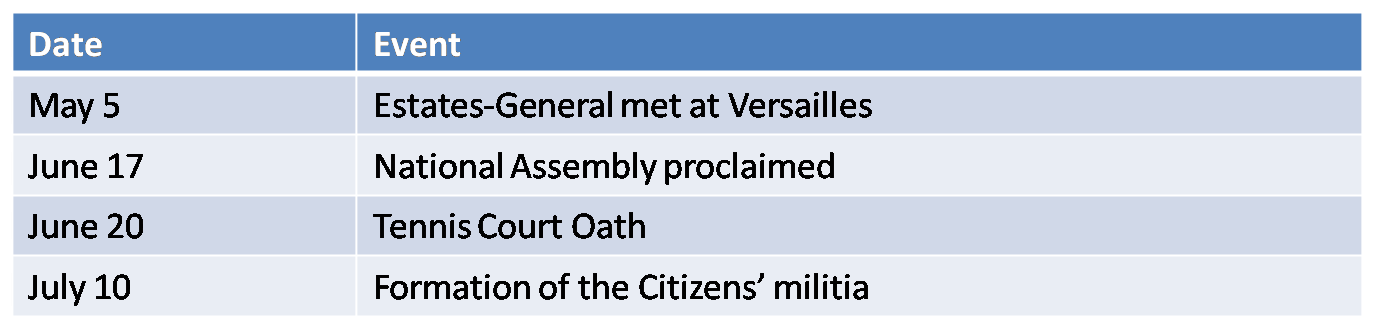
Estates-General Meeting 

  • All three Estates met on 5 May 1789 aimed to stop absolute rule and to limit the King with an elected assembly.
     
  • The Third Estate declared themselves National Assembly on June 17. The Clergy voted to join on June 19th.
     
  • A royal session was prepared by the King to announce reforms in reaction on June 23.
     
  • The Third Estate were not allowed in their usual hall on 20th June as it was being prepared for the Royal Session. They instead met outside in a tennis court…

Tennis Court Oath
  • Call to remain united.
     
  • Pledged to remain until the constitution was written “upon solid foundations”